Supplier Portal
Make supplier collaboration more controlled, visible and operationally useful
Proplix helps connect supplier workflows to the wider maintenance story so teams can assign work, follow progress, capture evidence and close out jobs with more confidence.
Assigned jobs
Give suppliers a cleaner view of what has been allocated and what is expected next.
Evidence capture
Support progress notes, photos and completion records in a more structured workflow.
Service accountability
Keep supplier interaction visible to the wider platform instead of isolated in email chains.
Supplier portal capability
Supplier portal features for job control, sign-off and paperless contractor workflow
The supplier portal should help contractors and service providers interact with allocated work in a more structured digital environment. Instead of relying on fragmented email chains and informal updates, suppliers should be able to see assigned jobs, acknowledge work, upload progress information, share documents and move through cleaner completion workflow.
For property businesses, this matters because supplier collaboration becomes more accountable and easier to manage when the workflow is visible, timestamped and connected to the wider maintenance and service record.
Secure supplier login and controlled job access
The supplier portal should give each contractor access only to the jobs and information relevant to their work, keeping the workflow clean and controlled.
- Supplier-specific login and access path
- Role-based visibility into allocated jobs
- Cleaner separation from internal-only records
- Improved security and workflow control
- Better relevance for external users
- More professional contractor experience
Job allocation, acknowledgement and acceptance workflow
Once a job is assigned, the portal should help the supplier acknowledge it clearly and move into the appropriate acceptance or progression state without relying on repeated manual coordination.
- Allocated job visibility
- Acknowledgement and acceptance pathway
- Status-led workflow progression
- Cleaner start-of-job coordination
- Reduced communication lag around allocation
- Improved operational accountability
Progress updates, notes, images and supporting uploads
The supplier portal becomes much more useful when contractors can share progress, upload images and preserve supporting context directly against the allocated job.
- Job progress update support
- Image and evidence uploads
- Notes and supporting detail against the job
- Cleaner work-in-progress visibility
- Reduced need for fragmented update channels
- Better internal understanding of active work
Job reports, completion records and digital sign-off
Supplier workflow should end with a clean digital record of completion, including job reports, final notes and sign-off-ready workflow where appropriate.
- Completion reporting support
- Final job-note continuity
- Digital sign-off and acknowledgement direction
- E-signature-ready completion flow support
- Cleaner close-out process
- Stronger service record quality
Documents, work instructions and downloadable files
Suppliers need the right instructions, attachments and documents in one place so work can proceed without repeated requests for the same information.
- Job-linked documents and supporting files
- Digital instructions and reference access
- Cleaner download and file-visibility pathways
- Reduced confusion around work context
- Improved operational speed
- More professional supplier coordination
Paperless go-green supplier workflow
A digital supplier portal reduces the need for printed job sheets, scanned paperwork and manual document circulation, helping the whole maintenance process stay more paperless and efficient.
- Reduced printing and manual paperwork dependence
- Digital work records and uploads
- Cleaner go-green service delivery model
- Improved administrative efficiency
- Better digital continuity across outsourced work
- Stronger sustainability message in operations
Notifications, communication continuity and timeline support
Suppliers work more effectively when the portal makes updates, relevant status changes and communication context easier to follow over time.
- Status-led visibility for active work
- Cleaner communication and progress continuity
- Reduced repeated clarification requests
- Improved internal and external coordination
- Better trust in the job workflow
- More reliable service progression tracking
Audit trail, timestamps and contractor accountability
A supplier portal is stronger when updates, uploads and completion activity help build a clearer digital trail around outsourced work.
- Timestamp-aware contractor activity
- Digital chronology for allocated jobs
- Improved accountability for progress and completion
- Better internal reference value
- Cleaner dispute and review support
- More mature outsourced-work management
Why the supplier portal matters
A stronger supplier portal improves contractor coordination, record quality and paperless service delivery
Property businesses often depend on external suppliers, so clearer digital coordination matters. A supplier portal helps reduce confusion around allocated work, supports cleaner evidence handling and improves visibility over progress and completion across the job lifecycle.
Proplix becomes more compelling when the supplier portal is presented as a controlled digital workspace for outsourced work: one place for instructions, updates, uploads, sign-off-ready workflow and more accountable paperless service delivery.
Frequently asked questions
Frequently Asked Questions
Practical answers to common questions from UK letting agents, landlords, property managers and operational teams evaluating this area of Proplix.
What is the purpose of the Portals – Supplier Portal page?
The portal pages are there to explain how a specific external user group benefits from clearer visibility, better communication and a more controlled service experience through Proplix.
Are portals really important for UK property businesses?
Yes. For many British agencies and managers, portals can reduce unnecessary back-and-forth communication and make the service model feel more professional.
Does a portal replace direct communication?
No. A portal should improve communication quality, not remove human contact. It helps the right information stay visible in the right place.
How do portals help internal teams?
They reduce avoidable admin, make updates easier to follow and help internal teams keep service delivery more organised.
Can portals improve landlord and tenant confidence?
Yes. Better visibility usually leads to better trust because people can see status, updates and relevant information more clearly.
Why does Proplix include a supplier portal as well?
Because maintenance and service delivery become more useful when suppliers are also working within a clearer and more accountable workflow.
Is the portal story separate from the rest of the software?
No. The portal routes are written as part of the wider one-window platform story, so they connect back to workflow, maintenance and operational control.
Will this help agencies look more professional?
Yes. A cleaner portal experience can support a more premium and more modern service model for agencies and property managers.
Why is there a full page for each portal audience?
Because each audience has different needs, and detailed pages make it easier to explain the practical value for landlords, tenants and suppliers separately.
What should I view after this page?
The next step is usually the related solution page, a feature route such as maintenance or property management, or the commercial proposal process if you are ready to discuss implementation.
Platform illustration
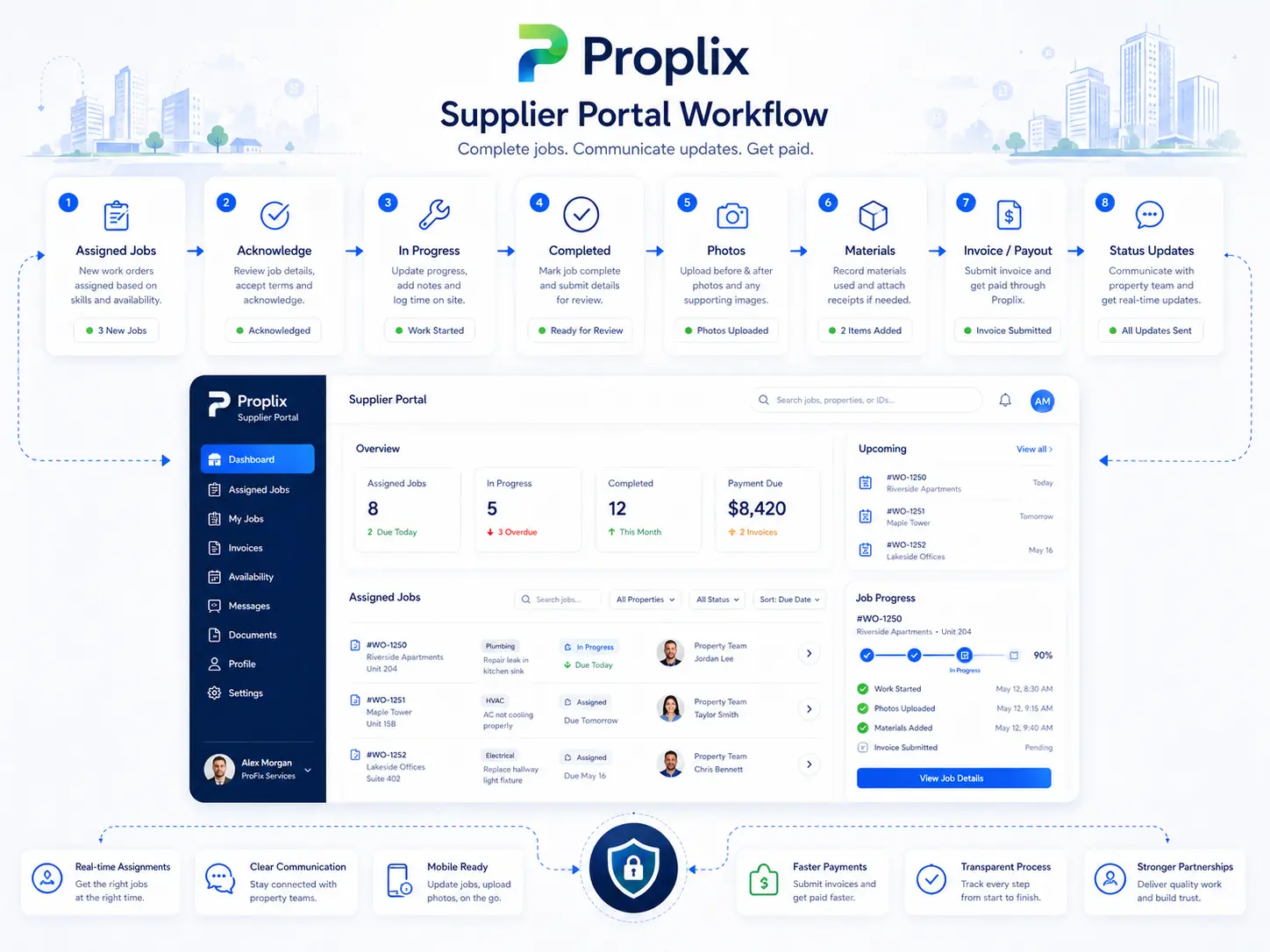
A visual view of the supplier portal journey
This illustration helps explain how supplier collaboration becomes more controlled when jobs, updates, evidence and completion signals sit inside one connected operational environment rather than being tracked informally.
A controlled view for each participant
How Supplier Portal fits into dependable property operations
A credible workflow connects everyday actions with the records and responsibility needed to explain the outcome later. A portal should not be a second disconnected database. It should present an authorised view of the same property operation so that a request, document, decision or update remains connected with the internal record that staff use.
Give each role enough context to act
Different participants have different reasons for signing in. A tenant may report a repair, a landlord may review portfolio activity, a supplier may update a job and a staff member may need wider operational context. Permissions must follow those responsibilities precisely. For Supplier Portal, that means access should follow an evidenced business need and change when responsibility changes.
Keep the reason beside the action
Good portal workflow confirms what was submitted, who now owns it and what the participant should expect next. Internal teams should receive enough context to act without asking the user to repeat information already supplied through the portal. This makes the Supplier Portal record more useful during absence, escalation, service review or a later audit.
Design for the case that does not fit
Property work includes incomplete forms, late evidence, changed instructions, unavailable suppliers and circumstances requiring discretion. The system should expose those exceptions, preserve notes and direct them to an authorised person instead of silently forcing a misleading “complete” status.
Configure from representative work
Before launch, test ordinary and awkward journeys with representative users, including missing evidence, incorrect selections, delegated access and closed cases. Clear labels, accessible forms and reliable failure messages matter as much as the visual design. Document what remains outside the system as well, so teams understand the boundary between Proplix, connected services and professional responsibility.
Measure whether the work is improving
Review successful task completion, repeat contact, abandoned journeys, response times and permission-related incidents. A portal is useful when it removes uncertainty while preserving human support for situations that do not fit the standard route. Review findings with the people completing Supplier Portal work, because a dashboard may not reveal the manual workaround being used beside it.
Keep guidance, permissions and records current
Ownership, legislation, services and internal policies change. Schedule periodic checks of access, templates, notifications, integrations and retained information. Record material changes and brief affected users so the configured workflow continues to reflect the organisation’s approved way of working.
Proplix supports structured workflow and evidence handling; it does not provide legal advice or remove the need for competent human review. Discuss your organisation, migration or integration requirements through the central secure enquiry route.
Discuss Supplier Portal requirements →What a well-run Supplier Portal process should make clearer
A member of staff opening the record should be able to understand its purpose, current status, owner and next meaningful action without first asking several colleagues for background. That does not mean every case follows an identical path. It means the agreed route is visible, departures are explained and supporting material remains beside the decision it informed. For Supplier Portal work, clarity is especially important when the case moves between teams or returns after a period of inactivity.
The day-to-day experience should also make uncertainty honest. Missing evidence, a disputed instruction or a review awaiting specialist input should be shown as an exception, not hidden behind a reassuring colour or forced completion state. Managers can then direct attention where it is useful, while staff retain a record of the checks already completed. This approach supports a more natural conversation with landlords, tenants, suppliers, clients and colleagues because updates come from a current operational record rather than a hurried reconstruction.
Good information design reduces unnecessary detail without removing useful context. Labels should use the language the organisation actually understands; permissions should reflect real responsibilities; and notifications should be reserved for events that require awareness or action. When every minor system event generates an alert, important work becomes harder to see. A considered Supplier Portal configuration therefore balances automation with judgement and gives authorised users a practical way to explain, reassign or escalate unusual work.
Implementation is not finished when data has been imported or users have received a login. Teams need time to test live examples, compare the configured route with policy, correct weak source information and agree how questions will be handled after launch. Early reviews should look for duplicated entry, private spreadsheets, unclear ownership and steps that users routinely bypass. Those observations are useful evidence: they show where the design, training or operating decision still needs attention rather than placing all responsibility on the person using the system.
Over time, the organisation should be able to show whether Supplier Portal work is becoming easier to complete and easier to explain. Useful evidence may include fewer avoidable chasers, faster retrieval, more complete handovers, better-quality submissions and a smaller backlog of unresolved exceptions. Measures should be read alongside real cases and user feedback. Proplix provides the connected workspace for that improvement, while accountable people remain responsible for policy, professional decisions and the service ultimately delivered.